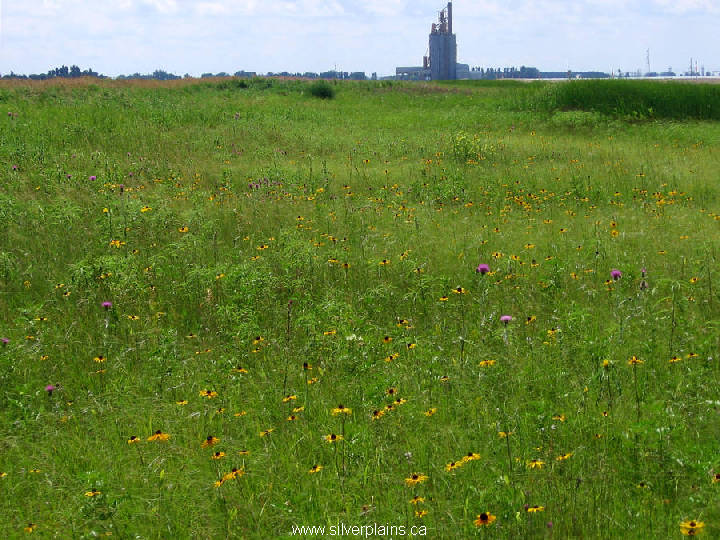
Tallgrass Prairie remnant just north of Letellier on east side of PTH 75.
I recently learned the phrase “Native plant” doesn’t mean anything to most residents of the RM of Morris. I was campaigning for election to the RM Council and while talking with people I realized that most of my neighbours do not know there are two kinds of plants growing in communal areas. Well, neither did I until about 10 years ago.
When I became aware of Native plants and started researching them I learned that early settlers of North America made a mistake. They did not keep in check many plants which tagged along in bags of grain and such or were imported for various reasons. Today we are living with the consequence: A host of introduced plants proliferate in highway ditches, along riverbanks, and in unused fields and field edges.

salt marsh caterpillar eating meadow blazingstar flower
By definition, a plant Native to North America is one which grew here prior to European settlement. Plants brought from elsewhere are called introduced, exotic, or alien. A significant difference between the two is Native flora is kept in check by Native fauna while introduced plants are not. For example salt marsh caterpillars eat the flowers of Native meadow blazingstar which slows down the plants’ propagation. No local insects eat the flowers of introduced dandelions.
Scientific classifications aside, I advocated starting a process of succession to bring Native plants back. ‘They make better neighbours’ I said. Native grasses and forbs (flowers) do not encroach on farm fields and, once patches are established, they keep out troublesome plants (called weeds) that no one wants around: dandelion, clovers, creeping thistle, sow thistle, and the like.
Let me elaborate: I live beside a farm field; a variety of Native plants are growing on my side of a 650 foot property line. Not one of them ever shows up on the farmer’s side. During my campaign I spoke with a man who told me about a 40 acre plot of prairie that had never seen the plough before he purchased it. ‘There were no weeds growing in it,’ he said. I have also visited a similar 40 acre patch of virgin prairie north of Stonewall. No weeds there. And, next summer, were you to venture over to the Natural preserves by Gardenton — Prairie Shore and Agassiz Interpretive Trails — you can see for yourself. No weeds (except in the areas which are mowed for parking cars and events).
While my main plank was perceived as advocating for the environment — which is considered by a lot of people to be the enemy of prosperity — I was (and still am) putting forth a practical solution to a pending problem: The Province’s ban on domestic herbicide use comes into effect next year. Perfect lawns in Rosenort and elsewhere are going to be a challenge to maintain.
Another facet of this is the other weed suppression method — mowing — doesn’t work to eradicate weeds. In some cases it actually helps their spread: Dandelion and sow thistle flowers still set seed after being cut from the plant which is then on the ground right where it is not wanted.
It’s worth observing that many States in the U.S. have roadside planting/replanting programs using plants Native to various regions. So does the United States Federal Government. They are doing this for two reasons: Native plants make better neighbours (as I mentioned) and to give regions distinctive looks. People grew tired of places looking the same everywhere in North America because introduced plants had taken over. Replanting to Native is a big deal south of the border.
It’s a numbers game. At present introduced plants outnumber Native plants partly because current practices favour them. Doing things to encourage Native plants instead would at some point tip the scale in their favour. A process of succession will take a couple of generations, to be sure. But, from what I’ve seen, most residents of the RM of Morris plan to stay here.
Robert G Mears
November 2014
(originally published in The Southeast Journal, November 29, 2014)
Comments (2)