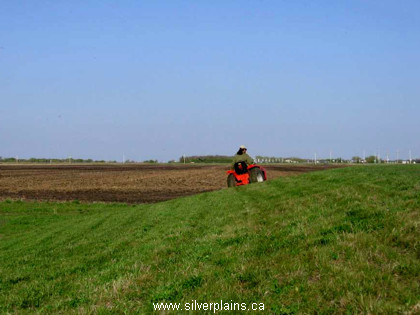
imitating a horse
One of the most powerful forces in human society generally goes unnoticed. It's like putting on shoes; something one does without thinking because a habit was formed when one first started putting on shoes. Such a habit is a good thing:
Having to think about which shoe to slide a foot into first would waste time.
Conventions are habits on a grander scale. They are, in the abstract, neither good nor bad. Like habits they are obliged without thinking. And, like some habits, they can have harmful effects.
All Conventions start somewhere. What was perceived to be of value at the time either got them started or extraneous conditions allowed them to happen. Take the Convention of wrapping gifts in paper. Trees (as a source of paper) were abundant and people were few when the practice came into vogue. Now, however, people are many and trees are in short supply. Were gifts wrapped in some other material (or not wrapped at all) harvesting of trees would be reduced; especially with annual gushes like the exchanging of gifts during winter solstice (aka Christmas). Changing that single societal habit would alleviate a stress on the biosphere.
Oddly, self-evident though the preceding is, pointing it out is a good way to get most people to move to another couch. Like habits, Conventions are powerful.
a biospheric negative illusion
The dominant domestic landscaping form in North America has a short history. It is rooted in what happened around estates of the wealthy in Europe back in the days when horses provided transportation:
Keeping horses (which was synonymous with being wealthy) meant grass and herbaceous vegetation around such properties was short.
Subconsciously, a lawn gives the appearance of wealth. While today this is often an illusion, a multi-billion dollar industry helps to maintain it; an industry which drains money from local communities:
Mowers, et cetera, are imported from elsewhere.
And, while the "look" of mowed areas is seen as normal by many people, expanses of billiards flat say nothing about a region except humans (some with mowitus) live here.
Coincidentally another human practice harms the Biosphere. The Convention started back when the Great Plains of North America were being settled by Europeans. A few erudite gentlemen — of Victorian vintage — launched an idea which they labelled Landscape Gardening. Andrew Jackson Downing and Frank Jesup Scott purported that Nature was messy and needed improving:
They posited and popularised the form of an area around one's buildings of kept short grass ringed with showy flowers and shrubs and trees. Keeping the grass short was enabled by the invention of a mechanical device — the lawn mower — otherwise it may have been a hard sell.
Aside from the deleterious effects of lawns (which provide habitat for mosquitoes, worms, and ants) their Convention — which is now ubiquitous — may not have been as damaging as it presently is had Messrs Downing and Scott not insisted on promoting the use of exoticWhile the word exotic has a nice ring to it, it simply means from elsewhere. plants.
This last appears rooted in the Capitalist proclivity of advancing ideas that have products attached to them. There was, to be sure, some money to be had in promoting and selling a device to mow grass. But if one could convince the locals that flora from elsewhere was preferable to the forbs (flowering plants), grasses, shrubs, and trees already growing in North America, then there was a serious market, one with repeat business. A hundred and seventy years later a trip to any Garden Centre in Canada or the United States will have most people coming home with a trunk load of almost if not entirely plants from elsewhere.
The Landscape Gardening Convention of expansive lawns with pocket gardens of mostly alien flowers and shrubs, et cetera, (plus attendant chemicals) is an assault on Native ecosystems, on natural communities of plants and wildlife. Plants are either habitat or food to other lifeforms on planet Earth. Many insects and birds, in particular, rely on the plants they evolved with to sustain themselves; regional fauna often cannot get what it needs from foreign plants. Many exotic flowering plants stay in bloom for a long time because they are not being pollinated; while they provide visual appeal to humans they offer nothing for North American pollinators. Plus, chemical herbicide use is making the biosphere toxic and run-off from synthetic fertilizers contributes to eutrophicationEutrophication is the term for excess nutrients in water. It is the cause of algae blooms which turn otherwise life-sustaining waters into dead zones. in estuaries around the globe.
In some areas, watering lawns (to keep them green) contributes to aquifers being drained. Mowing also helps the spread of foreign plants like dandelionsEven though they are cut off from the plant dandelion flowers still set seed which is lying on the ground right where the plant is not wanted. or European clovers and thistles. Left unchecked, plants from foreign places are a cause of extinctions — of both flora and fauna — in ecosystems where they don't belong. As well, the air temperature above large mowed areas, like those one encounters in rural areas — five to ten acres of religiously kept short grass (and weeds) — is at least two degrees Celsius higher than the same area with unmowed Native grassland.
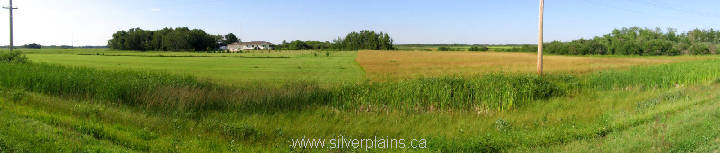
mowed (30°C) | not mowed (28°C)
Borrowing from the plus/minus method used to rate athletes, it can be said without hesitation:
The current dominant landscaping model in Canada and the United States is biospheric negative.
a biospheric positive certainty
Plants that are Native to various regions around the globe are adapted to extremes of climate and moisture conditions; once established, they do not require much, if anything, in the way of inputs — fertilizer and watering or soil amendments — to keep them healthy.
Native plants are as beautiful as foreign plants. Perhaps because they are adapted to the soils where they evolved, Native plants have a subtle glow to them that foreign plants lack. It’s like the difference between gold and brass.
Plus Native flora does double duty. It provides food and habitat for Native fauna.
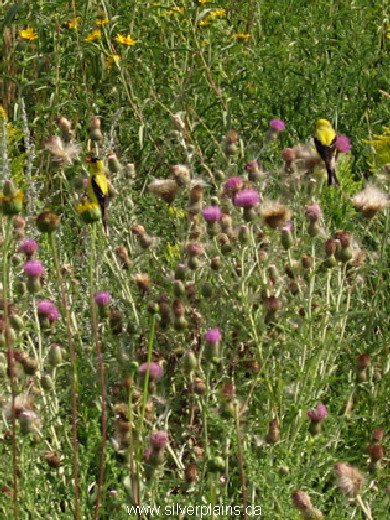
American goldfinches love Flodman's thistle seed. Meanwhile people import Niger seed for the bird.
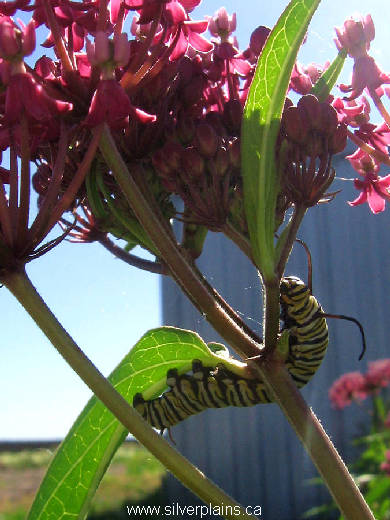
Monarch caterpillar on swamp milkweed
Whether in small or large scale plantings, inclusion of Native plants in domestic landscaping is biospheric positive.
a U-turn
I have been on two 10,000 km motorcycle rides from points in Canada to places in the U.S. and Mexico. In some areas I didn't have a map for which I developed what I called the five kilometre rule:
If the road I was on didn't seem to be where I was headed after 5 km I would turn around and go back to where I started and take a different route.
This “rule” served me well.
It has been more than seven generations since Downing and Scott set us on the current path. It is clearly yielding deleterious consequences. It is time to turn around, to go back to where we started.
A couple of people I've met within the loosely defined Native plant community have suggested that the practice of planting anything but Native will not change because the Garden Centres would put themselves out of business if people were planting indigenous flora instead of exotic plants. They have a point. But it's a small one:
Given the extent of damage to pre-existing ecosystems and given the degree of difficulty one encounters when replanting to Native, it will be two human generations before Garden Centres would run out of customers. That's plenty of time to adapt, to find or develop new markets. Besides which, future gardeners — as they have done in the past — will always be changing things and what is at stake here is only the palette not the practice.
Today, regard for the so-called Natural world, for Native flora and fauna, is the exception. Meanwhile, it would benefit everyone, including species beyond our own, if a new Convention were to replace the current one; a Convention where respect for all life and the Natural world is the rule or governing principle.
Robert G Mears
October 2014
Comments (1)