Rosa arkansana

characteristics
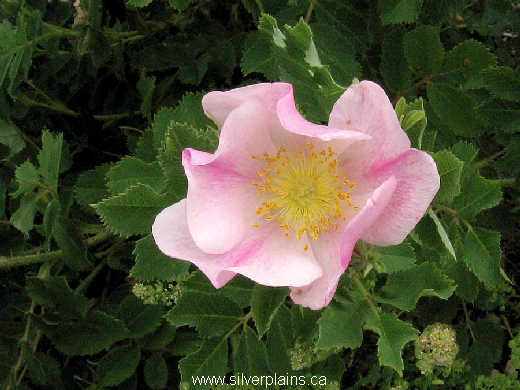
A commonly found low subshrub. Stems are very prickly/thorny. White to pink flowers are in small clusters on new growth stems; sometimes on short branches of older stems. Flower buds are deep pink. Leaves: sharply toothed, oval to oblong and fuzzy beneath. Fruit: bright red to purple berries/hips which remain throughout winter. Drought resistant; roots may reach 6 m.
Starts from seed, cuttings.
| T | SSN | H | W | sun | soil | H2O | fire | N2 | pH | summer | fall | flower (seed) |
|---|---|---|---|---|---|---|---|---|---|---|---|---|
| SS | CW | 1.2 | 0.2 | S/PS | F-M-C | DM | • | - | 5.6-7.0 | green | grey | pink-white |
habitat
Fields, roadsides, open woodland and thickets.
uses
Rose hips contain high levels of vitamin C. May be eaten raw, stewed, candied.
Important food source for snowshoe hares, jackrabbits, and rodents as well as larger mammals: bears, beaver, deer.
Songbirds and gamebirds eat both buds and hips.
North American aboriginals made a medicinal tea from the flowers for diarrhea and stomach complaints. A compress using boiled roots was used to reduce swelling.
The hips were an emergency food source for Plains Indians.
Comments