Schoenoplectus pungens


characteristics
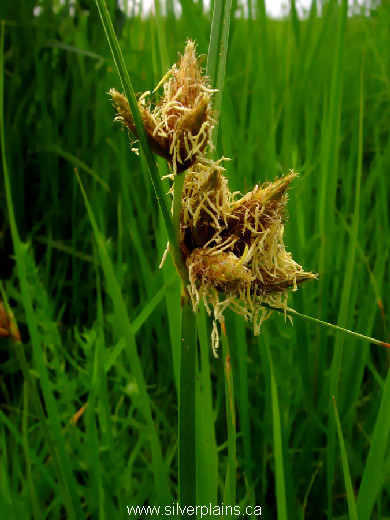
Rhizomatous perennial with small, brown, terminal spikes in a rounded, compact, cluster. Leafy bracts extend beyond the seed clusters. Also known as chairmaker’s rush.
Starts from seed or rhizomes.
| T | SSN | H | W | sun | soil | H2O | fire | N2 | pH | summer | fall | flower (seed) | |
|---|---|---|---|---|---|---|---|---|---|---|---|---|---|
| P | CW | 1.0 | SB | S | S/PS | M-C | M-W | •• | - | 5.2-8.5 | green | yellow | green (brown) |
Habitat
likes wet sandy or gritty areas such as marshes, ponds, streambanks, ditches.
uses
The seeds/seedheads of this plant and other bulrushes are an important source of food for many wetland birds, including ducks, geese, rails, and some granivorous songbirds. ... Common Three-Square and other bulrushes also provide suitable cover, foraging, and nesting habitat for many wetland birds. This includes such species as the Marsh Wren, Yellow-headed Blackbird, Canvasback, Ruddy Duck, American Bittern, Virginia Rail, Sora, Common Moorhen, and Wilson's Snipe (DeVore et al., 2004). Muskrats feed on the rootstocks and aerial stems of these plants. (Illinois Wildflowers)
Excellent for reconstructed wetlands:
Removes Nitrogen (N2) and phosphorus (P) from water.
Comments